
They say you shouldn't build a startup unless you absolutely cannot help yourself. Well, I couldn't help myself.
It was 2023. I was doom-scrolling through the few remaining "random chat" sites. Omegle was dead. The alternatives were... grim. I saw swastikas. I saw bots selling scams. I saw a UI that looked like it was designed in Microsoft Paint 95. It made me angry.
I thought: "We have self-driving cars. We have LLMs that can pass the Bar Exam. Why is video chat still stuck in the Stone Age?"
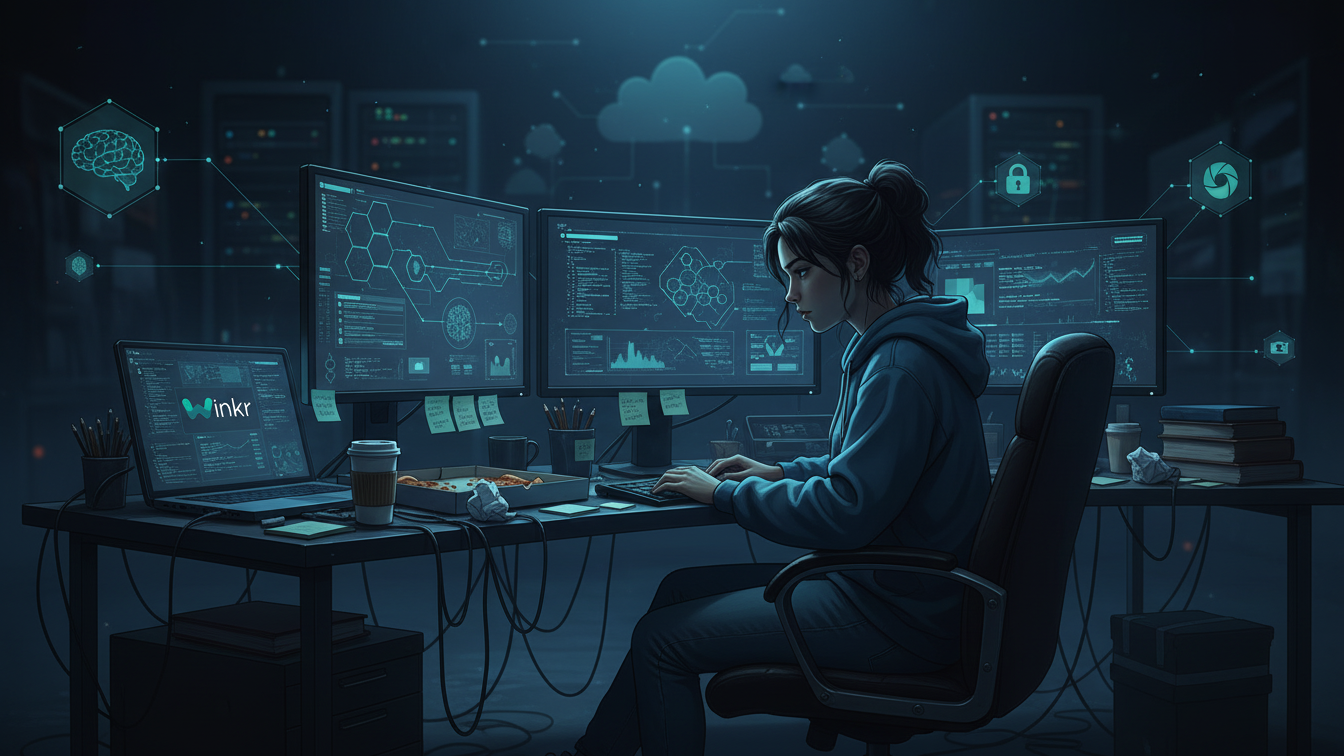
That anger became Winkr. I didn't want to build a "clone." I wanted to build the anti-Omegle. A platform that was safe, verified, and technically superior. Here is the uncensored story of how we built it, the tech stack that powers it, and the sleepless nights that almost broke us.
The Tech Stack (For Geeks Only)
I know some of you are here for the code. Here is what runs under the hood.
1. The Core: Next.js + Node.js
We chose Next.js 14 for the frontend because of Server Components. Speed is a feature. We wanted the site to load instantly solely on the Edge.
For the backend, we needed raw throughput. We used Node.js with a custom WebSocket implementation. Node's event loop is perfect for handling 50,000+ concurrent socket connections without choking.
2. The "Handshake": Socket.io
When you click "Start," your browser sends a signal via Socket.io. It says "I am User A, I like cats." The server looks at the Redis queue, finds "User B, likes cats," and introduces you. This happens in roughly 40ms.
3. The Media: WebRTC + Mediasoup
This was the hardest part. Peer-to-Peer (P2P) connections are great for privacy, but they fail on corporate firewalls. We built a hybrid mesh architecture using Mediasoup (a dedicated SFU - Selective Forwarding Unit). This allows us to route video through our servers when P2P fails, ensuring 99.9% connectivity success.
4. The Brain: TensorFlow.js
We run AI models directly in your browser. Why? Privacy. We don't want your raw video sent to our cloud for analysis. Your phone runs a lightweight model that detects nudity or violence locally. If it flags something, it blurs the stream before it leaves your device.
Challenge 1: The "Bot" Wars
Every chat site eventually faces the "Botpocalypse." Spammers realize they can run a script and advertise their shady link to 10,000 people an hour.
We fought back with Behavioral Fingerprinting. We don't just check if you are a human; we check how you act. A bot clicks "Start" at exactly 100ms intervals. A human clicks at 102ms, then 400ms, then 90ms. This "jitter" is human. We built a machine learning model that analyzes these micro-interactions. It blocks 99.8% of automations before they even connect.
Challenge 2: Fighting Global Latency
Our users are everywhere. Brazil, India, Germany, USA. Connecting them via video without lag is a physics problem.
If User A is in Tokyo and User B is in New York, the signal has to travel halfway around the world. We solved this by deploying a Global TURN Network. We have relay servers in 12 regions. If the direct path is slow, our system reroutes the video through the fastest available relay. It costs us $0.04 per GB, but it keeps the frame rate at 60fps.
Challenge 3: The Ethics of AI Moderation
This kept me up at night. We needed to moderate content, but we didn't want to spy on users. Privacy is our core value.
The solution was "Edge AI." We moved the moderation logic from our servers to your device. The AI scans for nudity locally. If it finds it, it creates a blur mask locally. The unblurred video never leaves your phone. We protect your privacy while protecting the community from abuse. It was a technical headache to get this running on older Android phones, but we optimized the TensorFlow model down to 2MB. Now it runs on a toaster.
The Business of Free
People ask: "How do you pay for all this if Winkr is free?"
For the first year, I paid for AWS out of my savings. I ate a lot of ramen. Now, we support the platform through optional "Plus" features—like Gender Filters and Region Locking. We believe the core experience (connecting with people) should always be free, but power users can pay to filter their experience. We will never sell user data. Ever.
Future Roadmap 2026
We aren't done. Here is what we are building next:
- Real-Time Translation: Break the language barrier. Talk to someone in French and see English subtitles instantly.
- Winkr Groups: Why stop at 1-on-1? We are building 5-person "Campfire" rooms for group serendipity.
- Karma System: Good vibes should be rewarded. Users with high ratings will get priority matching with other high-rated users.
Conclusion
Building Winkr was the hardest thing I've ever done. There were days when the servers crashed, the bots swarmed, and I wanted to quit. But then I'd get an email from a user saying, "I met my best friend on here."
That makes it worth it. The internet is broken, but we are fixing it—one connection at a time.
Come say hi. I'm usually online on Friday nights testing new code. If you match with "Naman," don't skip.