

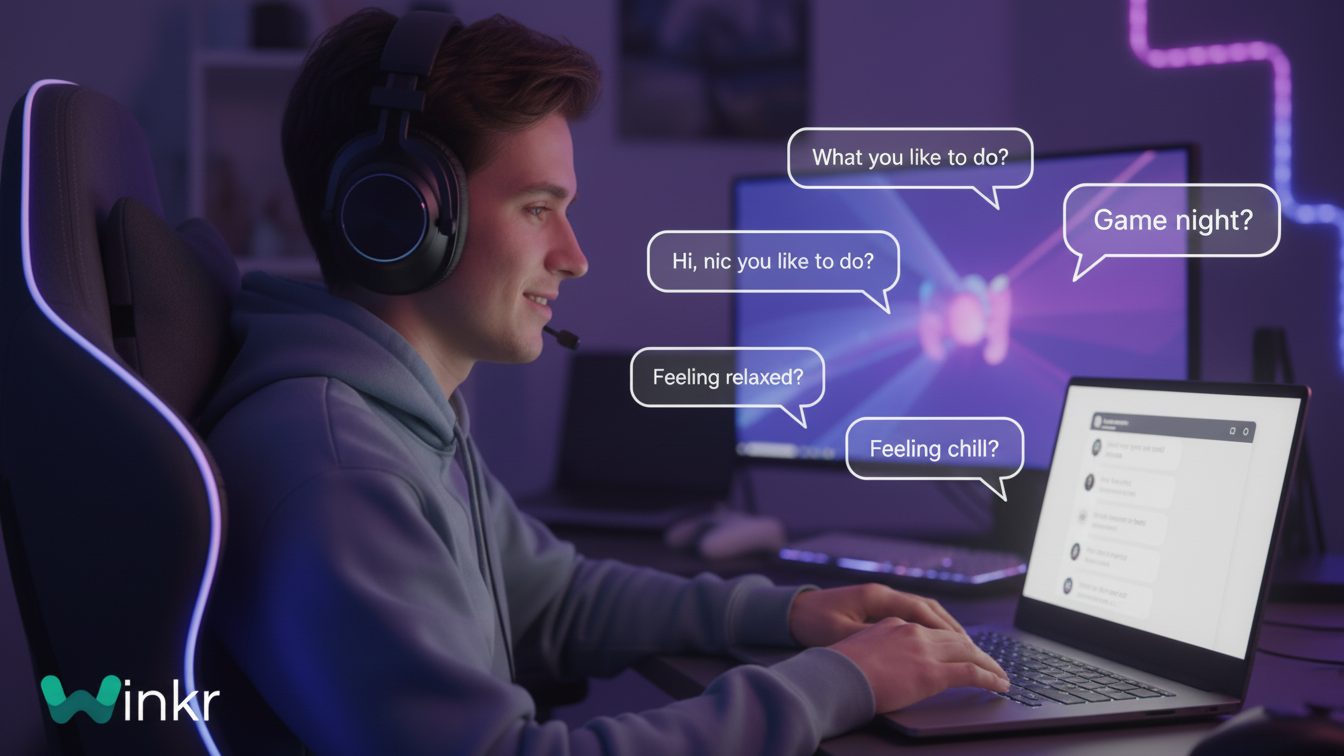
If the thought of tapping "Start" on a video chat app makes your heart race and your palms sweat, you are not alone. "Phone Anxiety" is a documented phenomenon, and video chat anxiety is its steroid-pumping big brother.
The fear usually boils down to a single, paralyzing question: "What if we have nothing to talk about?"
The silence. The awkward staring. The frantic mental scramble to find a topic before the stranger hits "Next." It’s terrifying. It feels like a performance review where you didn't study the material.
But here is the secret that extroverts know intuitively: Conversation is not a talent; it is a technology. It has rules, structures, and cheat codes. If you are an introvert, you don't need to change your personality. You just need a better script.
Here is a psychological deep dive into how to hack the awkwardness, reframe your anxiety, and turn "Introvert Panic" into "Quiet Charisma."
The Science of "The Spotlight Effect"
First, we need to debug your brain. The main driver of social anxiety is a cognitive bias called The Spotlight Effect. This is the false belief that people are paying way more attention to you than they actually are.
You think: "They noticed I stuttered. They noticed my hair is messy. They think I'm boring."
The Reality: They aren't thinking about you. They are thinking about themselves. They are wondering if their hair is messy. They are wondering if they are being boring.
Once you realize that everyone else is just as self-conscious as you are, the pressure drops. You aren't on stage performing for a judge; you are two awkward humans trying to survive a digital interaction. Your job isn't to be "Cool"; your job is to make them feel comfortable.
1. The "Prop" Method (Visual Anchors)
The biggest mistake introverts make is sitting in a plain beige room with nothing in their hands. This puts 100% of the conversational load on your face and your voice. That is heavy lifting.
The Fix: Bring a prop.
- Hold a pet: If you have a cat or dog, hold them. It is an instant win.
- Musical Instrument: Hold a guitar (even if you aren't playing it).
- Interesting Mug: Drink from a mug with a weird slogan or shape.
- Activity: Be solving a Rubik's cube or drawing.
Why it works: It gives the other person a Visual Hook. They don't have to rack their brain for a topic; they just have to look at your screen.
"Whoa, is that a Sphinx cat?"
"Do you actually know how to solve that cube or are you just fidgeting?"
Boom. The ice is broken. You didn't even have to speak. You outsourced the opener to the object.
2. The "Disclaimer" Opener (Radical Honesty)
We try so hard to look cool that we come off as stiff, robotic, or arrogant. The most disarming thing you can be is honest.
If you are nervous, say it.
The Script: "Hey, full disclosure, I'm super awkward at this, so you might have to carry the conversation for the first 30 seconds."
Why it works:
1. **It lowers the stakes.** You've already admitted you aren't James Bond, so now you can't "fail."
2. **It creates empathy.** 99% of people will laugh and say, "Oh my god, me too."
3. **It creates an alliance.** Now you aren't two strangers fighting for dominance; you are two awkward allies connecting over your shared humanness.
3. The "Barnum Effect" Question
"Small Talk" is the introvert's kryptonite.
"How are you?" -> "Good." (Dead end).
"Where are you from?" -> "London." (Dead end).
You want to ask questions that trigger the Barnum Effect—questions that feel personal but apply to almost everyone. You want to bypass the "Facts" and go straight to the "Opinions."
Try these High-Yield Openers:
- "Be honest, did you skip work/school to be here right now?" (Invites a conspiracy).
- "What is the weirdest thing you've seen on Winkr tonight?" (Invites storytelling/gossip).
- "If you had to rate your day on a scale of 1 to 10, but you can't say 7, what is it?" (Forces them to think).
These questions are impossible to answer with one word. They demand a story.
4. The "Sherlock Scan" (Environment Hacking)
Stop looking at your own self-view camera. Look at their background. Their room is a goldmine of data.
- Is that a poster on their wall? Ask about the band. Even if you hate the band, ask: "Are they actually good live?"
- Is it sunny outside their window? "Wait, where are you? It's pitch black here."
- Are they wearing a hoodie? "That looks wildly comfortable. What brand is that?"
People love talking about themselves. Just by noticing a detail about their existence, you make them feel "seen." It turns a random interaction into a personal one instantly.
5. The "Gamification" Mindset
Anxiety comes from fear of judgement. Gamification comes from the desire for a reward. You can hack your brain by changing the objective.
Stop treating Winkr like a "Social Interaction" (scary). Start treating it like a "Video Game" (fun).
Give yourself a quest before you log in:
- Quest 1: Make 3 people laugh.
- Quest 2: Find someone who has also been to Japan.
- Quest 3: Get someone to recommend a song to you.
When you have a "Mission," your brain focuses on the objective, not the fear. You stop worrying about how you look, and you start scanning for opportunities to win the game. The rejection (skips) doesn't hurt anymore, because it's just part of the grind level.
Conclusion: Embrace the "Next" Button
Finally, remember that the "Next" button is your friend. If a conversation is dying? Kill it.
The "Next" button is your friend. You do not owe a stranger 10 minutes of painful silence. If the vibe isn't there, if they are rude, or if you just run out of steam... kill it.
The Script: "Hey, it was cool meeting you, I'm gonna keep hopping. Have a good one!"
It’s not rude; it’s mercy. You are freeing both of you to find a better match. Confidence isn't about knowing exactly what to say every time. It's about knowing that if you mess up, you can just try again with a brand new human in 0.5 seconds.
You have infinite lives here. Play the game.