

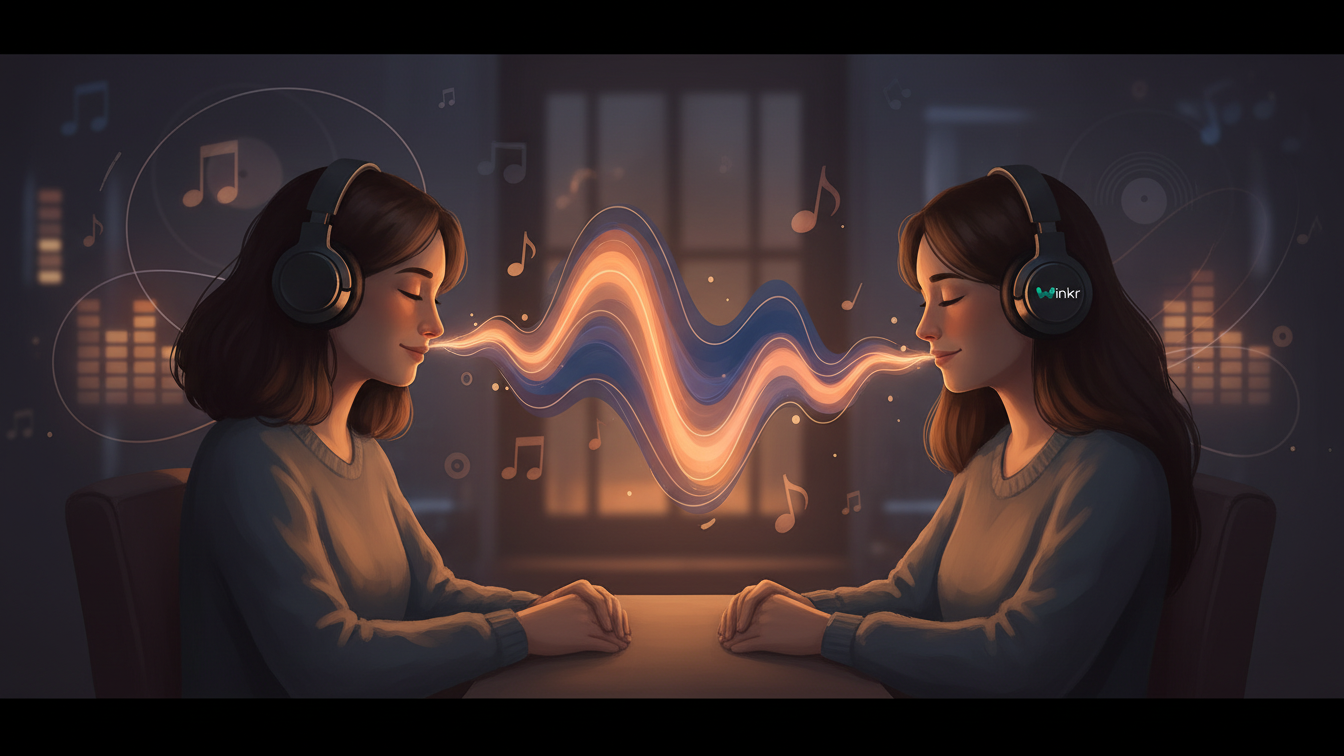
If eyes are the window to the soul, then ears are the backdoor key. We often treat music as background noise—something to fill the silence while we work or drive. But for human connection, music is a high-bandwidth data stream.
When you share a song with someone, you aren't just sharing a file. You are sharing a mood, a memory, and a specific vibration of your own internal state. "Music is what feelings sound like."
On Winkr, we recently analyzed the data from over 1 million "music-tagged" conversations. The result? Music compatibility is a stronger predictor of conversation length than age, location, or gender. Why?
The Science of Sync: Neural Entrainment
It turns out, this isn't just poetry; it's biology. Neuroscientists call it "Neural Entrainment." When two people listen to the same rhythm, their brainwaves literally synchronize. The beats per minute (BPM) of the track can align your heart rates.
By simply listening to the same track together, you are physically tuning your bodies to the same frequency. This reduces social friction. You are already "in sync" before you speak a word.
The 'Aux Cord' Anxiety
We all know the feeling. You are in a car with new friends. Someone hands you the aux cord (or connects you to Bluetooth). Suddenly, your palms sweat. "Will they judge me for listening to 2000s Pop Punk? Is Aphex Twin too weird? Is Taylor Swift too basic?"
This anxiety exists because music tastes are deeply personal. They reveal our "Shadow Self"—the part of us we usually hide. Sharing your playlist is a vulnerability test. If they reject your music, it feels like they are rejecting *you*.
On Winkr, we see this play out in real-time. When a user shares a Spotify link in the chat, there is often a pause. A moment of breath holding. And then, if the other person types "NO WAY I LOVE THIS ALBUM," the conversation explodes. The barrier is gone.
Winkr's Audio Tribes: A Field Guide
We mapped the "Tribes" of Winkr based on their most frequent tags. Here is who you will meet:
The Metalheads
Stereotype: Scary, angry, intense.
Reality: The undeniable "Golden Retrievers" of the platform. Metalheads are statistically the most polite and least likely to skip abruptly. They want to talk about theory, gear, and concerts. They are intense, but respectful.
The Sad Bois/Girls (Lo-Fi & Shoegaze)
Stereotype: Depressed loners.
Reality: The philosophers. If you match with someone listening to Slowdive or J Dilla at 2 AM, you are about to have a conversation about the meaning of existence. They are looking for "Vibes" and low-energy comfort.
The K-Pop Stans
Stereotype: Obsessive.
Reality: Highly organized and incredibly supportive. If you are having a bad day, find a BTS fan. They will hype you up better than your own mother. Just don't insult their bias.
The Techno/House Heads
Stereotype: Partiers.
Reality: Tech nerds. They want to talk about synthesizers, modular racks, and Berlin clubs. They are often coding or designing while chatting.
Lo-Fi Beats & Deep Talk
We noticed a fascinating trend. Users who tag "Lo-Fi," "Jazz," or "Ambient" have conversations that last 3x longer than users who tag "Pop" or "EDM."
Why? Because low-energy music creates a "safe container." It signals that you aren't looking to be entertained; you are looking to potential be. It invites vulnerability.
The Psychology of Playlist Swapping
Swapping playlists is the modern mixtape. It is a curated exhibit of your soul.
When you send someone a playlist, you are saying: "This is the map to my brain. This is what I cry to. This is what I drive fast to."
We encourage users to swap playlists early. It’s a low-stakes way to test compatibility. If they hate your music, they probably won't vibe with your personality. And that's okay. It’s a filter.
Audio Quality: The Hidden Signal
Finally, a note for the audiophiles (and everyone else). The quality of your microphone matters more than your camera.
Psychological studies show that people with clear, warm audio are perceived as more trustworthy, more intelligent, and more attractive than people with grainy, echoey audio.
Why? Because bad audio induces "cognitive load." The brain has to work harder to decode the words, which creates subtle stress. Good audio feels effortless. It feels like intimacy.
Conclusion: Listen First, Talk Second
In a world that is obsessed with visuals, we often forget the power of sound. But on Winkr, sound is everything.
So next time you log on, turn down the lights. Put on headphones. And listen. Not just to the words, but to the silence, the tone, and the rhythm of the other person. You might hear something amazing.