

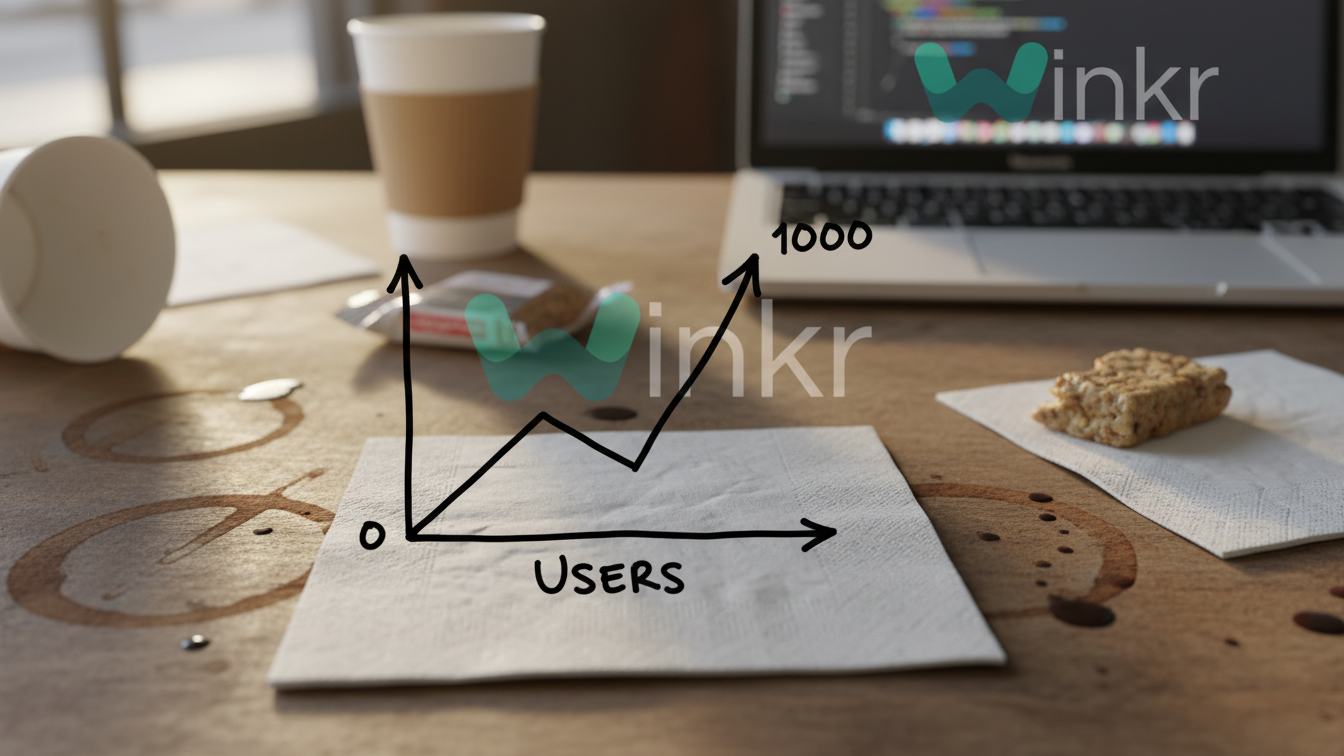
Every founder dreams of the "Hockey Stick." The moment you launch, tweet about it, and watch the user count go vertical.
For Winkr, that happened. We got 1,000 signups in our first 48 hours. We popped champagne. We thought we were rich. We thought we had won.
Then we looked at the Retention dashboard.
Day 7 Retention: 2%.
98% of people tried the app once and never came back. We weren't building a business; we were building a leaky bucket. If we had kept pouring money into ads, we would have gone bankrupt in a month.
Here is the story of how we stopped chasing "Vanity Metrics" and started solving the real problem.
1. Vanity Metrics vs. Sanity Metrics
In Silicon Valley, there is a saying: "Revenue is vanity, profit is sanity, cash is reality."
In the app world, it looks like this:
• Vanity Metric: Total Registered Users. (This number never goes down. It makes your ego feel good).
• Sanity Metric: Daily Active Users (DAU) / Monthly Active Users (MAU). (This tells you if people actually care).
We were obsessed with "New Signups." We celebrated every time the counter ticked up. But we were ignoring the "Churn Rate."
Churn is the silent killer. It’s like filling a bathtub with the drain open. It doesn't matter how fast the water comes in if it all leaves.
2. Finding the "Aha!" Moment
We paused all marketing. We stopped tweeting. We focused entirely on data analysis.
We took the 2% of users who did come back. We called them the "Super Users." We analyzed their behavior vs. the users who quit.
We looked for a pattern.
Did they use the mobile app? No.
Did they upload a profile picture? No.
Did they filter by gender? No.
The correlation was simpler: Conversation Depth.
Users who had at least one 5-minute conversation in their first session retained at 40%.
Users who only had 30-second chats retained at 0%.
The "Aha! Moment" wasn't "matching fast" (our original goal). It was "matching well."
3. The Pivot: Quality Over Quantity
This insight changed our entire product roadmap.
Before: Connect User A to User B as fast as physically possible (Speed Priority). Minimum Match Time: 0.5s.
After: Wait up to 5 seconds to find a Semantic Interest Match (Quality Priority).
We intentionally slowed down the app.
We added the "Interest Tags" requirement.
We added the "Icebreaker" prompts.
Users complained about the delay. "Why is it taking so long to find a match?"
But they stayed. They stayed because when they finally did match, they had something to talk about. The average session length tripled overnight.
4. The "Founder Welcoming Committee"
You can't automate empathy.
For the first 3 months, every time a new user signed up, they got a personal email from me. Not a Mailchimp template. A real email, written by a human.
"Hey, I saw you joined. I'm Naman, the founder. What is one thing you hate about the app?"
People were shocked. They replied. They gave us brutal feedback.
" The video quality sucks on 4G." (We fixed it).
" I keep matching with creeps." (We built the Vibe Algorithm).
These early users didn't just become customers; they became evangelists. They felt ownership over the platform because the founder actually listened to them.
5. Feature Flags & A/B Testing
We learned to stop guessing.
We implemented Feature Flags (using LaunchDarkly).
When we built "Dark Mode," we didn't launch it to everyone. We launched it to 10% of users.
We measured: Did the Dark Mode group stay longer? Yes (15% longer).
Only then did we roll it out to 100%.
This scientific method prevents "HiPPO" decision making (Highest Paid Person's Opinion). The data decides, not the boss.
Conclusion: Growth is Easy, Retention is Hard
You can buy growth. You can run Google Ads. You can pay influencers on TikTok to scream about your app.
But you cannot buy retention.
Retention is the measure of value. It asks: "Did you make my life better?"
For Winkr, the answer became "Yes" only when we stopped treating users like numbers and started treating them like people looking for a connection.