

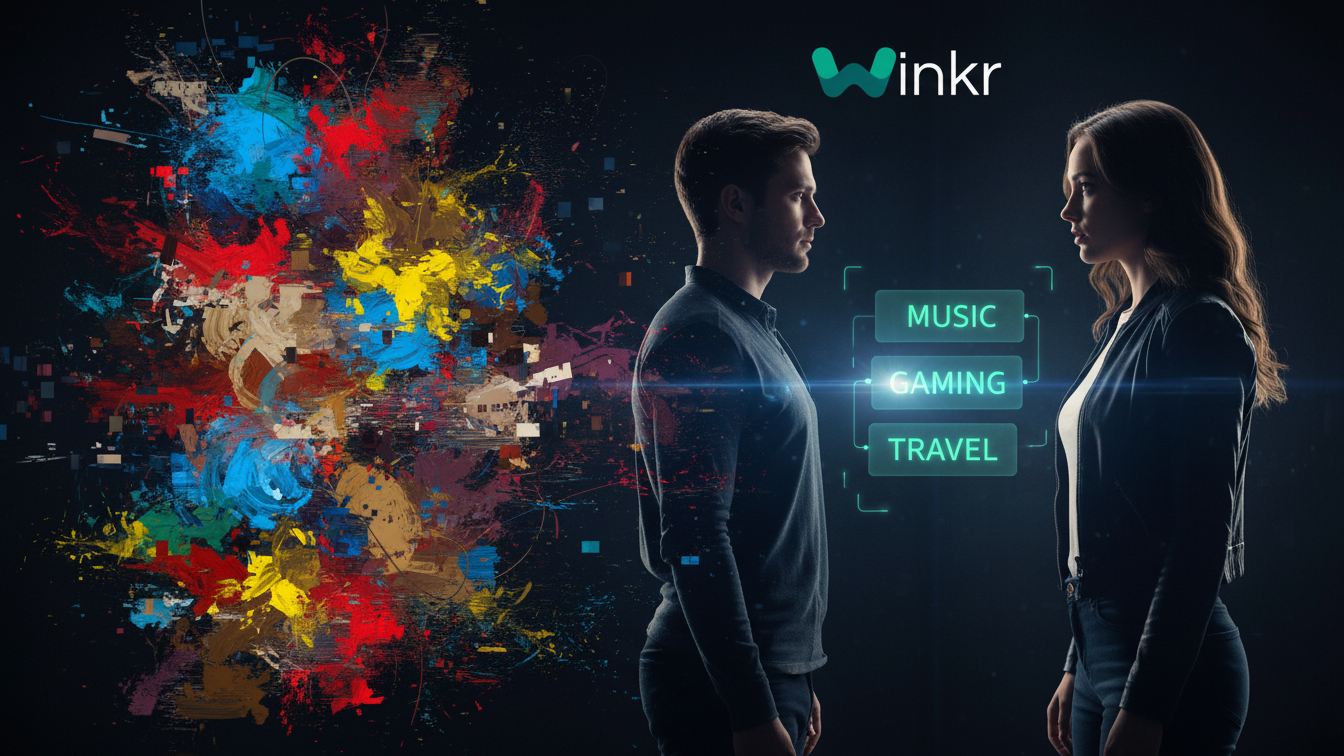
We’ve all heard it. It’s the golden rule of dating apps, the plot of every rom-com from the 90s, and the advice your grandmother gave you: "Opposites Attract."
The logic seems sound. If you are chaotic, you need someone organized. If you are shy, you need someone loud. It suggests that human connection is like a puzzle—we are looking for the missing piece that completes us.
It’s a beautiful, romantic idea. It’s also completely, scientifically wrong.
Especially when it comes to the lightning-fast, high-friction world of online interaction. In a context where you have approximately 3 seconds to make an impression before someone clicks "Next," relying on the mystery of opposition is a surefire way to end up staring at a black screen.
The truth—backed by decades of sociological research, evolutionary biology, and millions of data points from our own matching algorithm here at Winkr—is that Homophily (the love of the same) is the real currency of connection. We don't crave difference; we crave validation. We crave safety. We crave a mirror.
Here is the deep dive into why your brain effectively rejects "randomness," why shared interests are the greatest social lubricant in existence, and how Winkr’s vector-matching engine parses human psychology to engineer chemistry out of thin air.
The "3-Second Friction" Test
To understand why "Opposites Attract" fails online, you have to understand the cognitive load of a stranger chat.
Imagine walking into a crowded house party where you don’t know a single soul. You scan the room. Your brain is running a background threat-detection process at a rate of 100 calculations per second. Who do you walk up to?
Do you approach the person dressed in avant-garde fashion, speaking a language you don't recognize, holding a drink you’ve never seen? Probably not. That interaction requires High Cognitive Effort. You have to bridge a massive cultural gap just to say "Hello." You don't know the norms. You don't know the references. The risk of awkwardness is 99%.
Instead, you gravitate toward the person wearing a vintage t-shirt of a band you love. Or the person holding a craft beer you just tried last week. Why? Because that one visual cue acts as a psychological anchor. It signals: "We share a context. This interaction will be safe. I don't have to explain myself here."
In video chat, this happens 100x faster.
When you match with a stranger on Winkr, your brain screams three questions instantly:
- Is this person a threat? (Safety)
- Do we have anything to talk about? (Relevance)
- Will this be awkward? (Social Pain)
If the answer to #2 is "I don't know," the brain triggers a micro-panic. The silence stretches. The awkwardness spikes. To relieve that tension, you hit "Next." You didn't skip them because you didn't like them; you skipped them because the *friction* was too high.
The Science of Homophily
In 1954, sociologists Paul Lazarsfeld and Robert K. Merton codified this behavior as Homophily. Their study found that contact between similar people occurs at a significantly higher rate than among dissimilar people. This applies to everything: age, religion, occupation, and yes, hobbies.
Why are we programmed this way? It comes down to two evolutionary factors:
1. Predictive Safety
In the prehistoric savannah, a stranger was a potential enemy. If a stranger dressed like your tribe, spoke your dialect, and carried similar tools, your brain categorized them as "Ally." If they were totally different, they were categorized as "Risk."
In 2025, we aren't worried about spears, but we are worried about social rejection. Shared interests act as a proxy for "Tribal Membership." If you love Elden Ring and I love Elden Ring, I can reasonably predict that you categorize the world similarly to me. I know you value perseverance. I know you like fantasy. I "know" you before I possess any facts about you.
2. The Dopamine of Validation
We are ego-centric creatures. We want to believe that our taste in music, movies, and hobbies is correct. When you meet someone who loves the same obscure indie band, it validates your identity. It tells you: "You are not crazy; you have good taste."
This triggers a massive dopamine release. It creates an instant bond labeled "Us vs. The World." Opposites might provide novelty, but similarities provide serotonin.
How Winkr Weaponizes "Sameness"
Most random chat apps ignore this science. They throw you into a blender with the entire population of Earth—a 50-year-old accountant from Idaho, a 14-year-old gamer from Seoul, and a bot from Russia—and hope for the best. That’s why 90% of chats on traditional platforms end in under 5 seconds. It is a friction nightmare.
Winkr is built differently. We realized that "Randomness" is a bug, not a feature. You want serendipity (meeting a new person), not chaos (meeting an incompatible person).
To solve this, we built a Vector-Based Matching Engine.
The Difference Between "Tag Matching" and "Vector Matching"
Tag Matching (The Old Way):
User A tags "Cooking".
User B tags "Baking".
Computer says: "These are different words. No Match."
Vector Matching (The Winkr Way):
User A tags "Cooking".
User B tags "Baking".
Computer says: "Wait. These concepts map to the same semantic cluster [Food -> Creation -> Kitchen]. These users are 92% compatible."
Result: MATCH!
Our AI understands the meaning behind your tags, not just the spelling. It knows that "Coding," "Programming," and "Web Dev" are all the same tribe. It groups people by Semantic Proximity. This means you don't have to guess the "magic word" to find your people.
The Data: The "Duration" Metric
We don't just guess that this works. We track "Conversation Duration"—the gold standard of social success. A skip is a failure. A 10-minute chat is a victory.
Average Chat Duration on Winkr
- Random Match (No Interests): 18 seconds
- 1 Shared Keyword: 4 minutes 12 seconds
- 2+ Shared Keywords: 14 minutes 30 seconds
Let that sink in. Just adding one shared interest increases conversation length by nearly 1400%. That isn't a small optimization; that is a completely different social experience. It turns a "slot machine" into a "dinner party."
The "Icebreaker" Effect: Why It Works
The hardest part of any conversation is the first sentence. "Hi, how are you?" is the death rattle of a chat. It puts the burden on the other person to be interesting.
Shared interests solve the "Blank Page Problem." They give you a script.
Instead of "Hi," you say: "Wait, I see the 'Formula 1' tag. Did you see the race in Monaco?"
Boom. You are in. The awkward phase is skipped entirely. You aren't two strangers poking at each other; you are two fans debating a topic you both love. The conversation flows because the context is already established.
This is crucial for introverts. You don't have to be charming. You don't have to be funny. You just have to be knowledgeable about the thing you already love.
Case Study: The "Guitar" Experiment
To test this, we ran an experiment. We took a user (let's call him Alex) and had him use Winkr for one hour in "Random Mode."
Hour 1 (Random): Alex clicked "Start." He skipped 40 people. He talked to 5. The conversations were shallow: "Where are you from?" "USA." "Cool." *Skip*. He felt drained.
Hour 2 (Interest Mode): Alex added the tag "Guitar." He matched with fewer people (the pool was smaller), but the quality skyrocketed. He matched with a guy in Brazil who wanted to show him a riff. He matched with a girl in London asking for advice on strings. He spent 45 minutes talking to just 3 people.
The Verdict: Alex reported feeling "energized" instead of "drained." Connection gives energy; rejection takes it away.
Conclusion: Don't Be a "Blank Profile"
We see so many users leave their Interest Tags blank because they "want to be open to everyone." They think they are casting a wide net.
Don't do this.
Being "open to everyone" means you are relevant to no one. It forces every person you meet to do the heavy lifting of figuring you out. Most won't bother. They will take the path of least resistance and skip you.
Be specific. Be weird. Be you.
Tag your weird hobbies. Tag "Taxidermy" or "Sourdough" or "Speedrunning." The more niche you are, the smaller your pool becomes—but the deeper your connections will be. You are not looking for 1,000 matches; you are looking for the 10 matches that actually matter.
Opposites might attract in the movies. But on the internet, Similarity is Safety. Use it.