

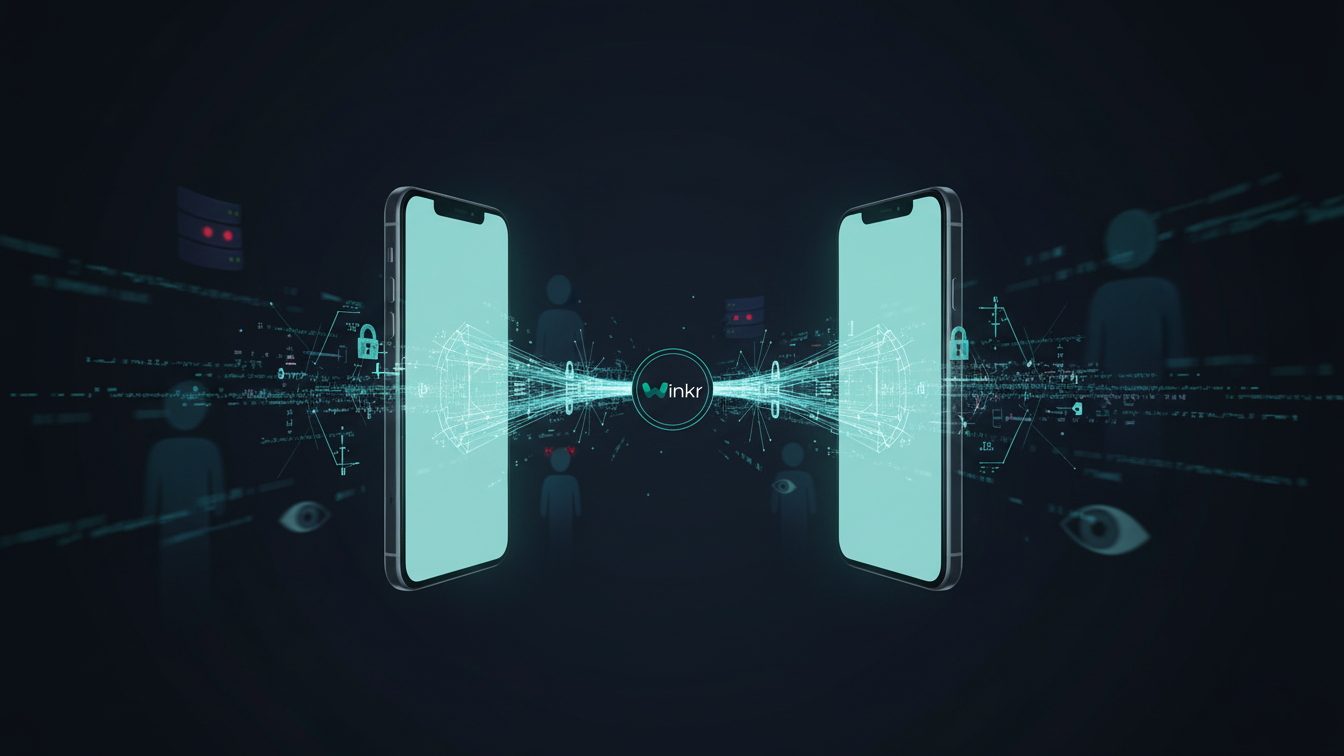
In 2025, privacy is no longer a luxury; it is a survival mechanism. We live in an era where data brokers trade your personal conversations like stocks, governments demand backdoors into messaging apps, and AI algorithms scan your "private" chats to serve you arguably creepily accurate ads. "Privacy" has become a marketing buzzword slapped onto every app in the App Store, but what does it actually mean?
When you strip away the marketing fluff and the sleek UI, how are your digital whispers actually being handled? Who holds the keys to your life?
At Winkr, we don’t want you to just trust us. "Trust us" is the lie that big tech companies have told you for a decade while selling your data out the back door. Instead, we want you to understand the technology that protects you. We rely on math, not promises.
This is the Ultimate Guide to End-to-End Encryption (E2EE). We are going to pop the hood of Winkr and show you exactly how your data travels from Point A to Point B without anyone—including us, the developers—ever seeing it. By the end of this article, you will know exactly why Winkr is considered the "Fort Knox" of random chat apps.
The Three States of Data (And Where They Fail)
To understand why E2EE is special, you have to understand how vulnerable data usually is. In computer science, data exists in three states:
- Data at Rest: This is a file sitting on a hard drive. If you steal the laptop, you steal the file.
- Data in Transit: This is data moving across the internet cables. This is where "Man-in-the-Middle" attacks happen.
- Data in Use: This is data currently being read by the processor (RAM).
The "Standard Encryption" Lie
Most apps use "Transport Layer Security" (TLS). You know this as the little green padlock in your browser. TLS protects data in transit. It creates a secure tunnel between you and the server (like Google or Facebook). But here is the catch: The server has the key.
When you send a message on a standard social app, it is encrypted from your phone to their server. The server then decrypts it, reads it (for content moderation, ad targeting, or storage), re-encrypts it, and sends it to your friend.
This means the company can see everything. If they are subpoenaed, they can hand over your chats. If they are hacked, your chats are leaked. They are the "Middle Man" in your conversation.
The Winkr Difference: Mathematical Blindness
End-to-End Encryption (E2EE) removes the middle man. It ensures that the "server" is blind. Even if a hacker compromised Winkr’s own infrastructure, or if a government agency seized our servers, they would find... absolutely nothing. Just random streams of noise.
Why? Because we never have the keys. The keys to decrypt your conversation exist only on your device and the device of the stranger you are talking to. They are generated instantly when you match and destroyed instantly when you disconnect. This is the gold standard of digital privacy.
How The Magic Happens: A Technical Breakdown
We use a customized implementation of the WebRTC standard (RTCDataChannel) secured by DTLS (Datagram Transport Layer Security) and SRTP (Secure Real-time Transport Protocol). If you aren't a cryptographer, here is what that means in plain English.
Phase 1: The Handshake (DTLS)
When our matching algorithm pairs you with a stranger, your devices perform a cryptographic "handshake." They exchange public keys. Think of this as swapping open padlocks. You give the stranger your open padlock; they give you theirs.
Crucially, this exchange happens directly between devices (Peer-to-Peer) whenever possible, bypassing our servers entirely. Even if it goes through a relay server (TURN), the padded envelopes are already locked.
Phase 2: The Ephemeral Key Generation
Once the padlocks are swapped, your browsers independently calculate a shared secret known as the Session Key. This key is used to lock and unlock the actual video, audio, and text data using AES-256-GCM (Advanced Encryption Standard with a 256-bit key in Galois/Counter Mode).
Fun Fact: AES-256 is so secure that if you used the world's fastest supercomputer to brute-force guess the key, it would take longer than the age of the universe to crack it. It is the same standard used by the U.S. military for Top Secret communication.
Phase 3: The Transmission (SRTP)
Your video frames are chopped up into thousands of tiny packets. Each packet is encrypted with the Session Key and sent over the internet via UDP (User Datagram Protocol). If a hacker intercepts these packets at a public Wi-Fi router, they just see random, high-entropy noise.
Phase 4: Forward Secrecy
We implement Perfect Forward Secrecy (PFS). This means that even if a hacker recorded your encrypted traffic today and somehow stole your private key 10 years from now, they still couldn't decrypt the past conversation. Every session generates a unique, throwaway key that is never stored to disk.
Privacy Advantages Over Other Platforms
Let’s compare Winkr’s architecture to the "standard" model used by many social apps (Facebook Messenger, Instagram DMs, Discord). The difference is foundational.
| Feature | Standard Chat App | Winkr (E2EE) |
|---|---|---|
| Message Storage | Stored indefinitely in Cloud DBs | Zero Persistent Storage (RAM Only) |
| Server Access | Admins/Employees can access | Technically Impossible to Access |
| Data Mining | Scanned for ad targeting | No Scanning (We are blind) |
| Legal Subpoenas | Company must hand over chat logs | We can't hand over what we don't have |
| Hack Risk | High (Centralized Honey Pot) | Near Zero (Decentralized) |
Most apps want to read your messages because they mine them for ad data. They are "free" because you are the product. Winkr’s business model is fundamentally different. We don't sell data. We provide a secure utility.
The "Admin Panel" Myth: Many users assume that every app has a secret "God Mode" admin panel where developers can spectate chats. On Winkr, this panel does not exist because the architecture doesn't support it. To spectate a chat, we would need the Session Keys, which never leave your device.
Metadata: The Invisible Footprint
Encryption protects the content of your chat. But privacy advocates know that metadata (data about data) is often just as dangerous. Metadata tells a story: "Who did you talk to? When? For how long? From where?"
Most encryption apps still log this metadata. Winkr minimizes it aggressively.
1. No PII Required
We do not ask for your email, phone number, or Facebook login. Your "identity" on Winkr is a cryptographically generated UUID (Universally Unique Identifier) that changes if you clear your browser cache. We cannot link your chats to your real-world identity because we never ask for your real-world identity.
2. IP Address Masking (TURN Relays)
Since Winkr uses Peer-to-Peer (P2P) technology to reduce latency, there is a theoretical risk that a sophisticated user could see your IP address during the connection handshake. To mitigate this, we employ a global network of TURN (Traversal Using Relays around NAT) Servers.
When you connect to a stranger, you aren't connecting to them directly; you are often connecting to a blind relay server that acts as a secure bridge. The stranger sees the IP address of the bridge, not you. This double-blind routing ensures location privacy.
Common Myth: "If I have nothing to hide..."
This is the most dangerous fallacy on the internet. You do have things to hide. You hide your credit card number. You hide your medical records. You hide your private conversations with your spouse.
Privacy isn't about secrecy; it's about agency. It's about having the power to decide who sees what. In a physical home, you have curtains. You don't have them because you are building a bomb; you have them because you don't want strangers staring at you while you eat dinner. Encryption is simply digital curtains.
Protection Against Modern Cyber Threats
Winkr’s security layers go beyond just encryption. We fight the modern threats of 2025:
- AI Phishing Defense: Malicious actors now use AI to generate convincing phishing scripts. Our text-analysis algorithms (running locally on your device, not our servers) flag suspicious link patterns and block clickable URLs from untrusted accounts.
- Screenshot Blocking (DRM): While no browser-based tech is perfect, we use EME (Encrypted Media Extensions) to make it difficult for screen recording software to capture video streams. On our mobile app, screenshots are completely disabled at the OS level during Private Mode.
- Session Hijacking Prevention: We use strict Content Security Policy (CSP) and HttpOnly cookies to prevent Cross-Site Scripting (XSS) attacks that could steal your session token.
The Future: Post-Quantum Cryptography
Security is an arms race. The next big threat is Quantum Computing. A sufficiently powerful quantum computer could theoretically break AES-256 encryption in seconds using Shor’s Algorithm.
While this tech is still years away, Winkr is "Quantum Ready." We are currently testing Lattice-based cryptography (Kyber/Dilithium algorithms) which is resistant to quantum attacks. We believe in protecting your data not just for today, but for 2035.
Summary: Why Winkr is the Secure Chat Choice in 2025
You wouldn't have a private conversation in the middle of a crowded stadium. So why would you chat online without E2EE?
Winkr isn't just about fun; it’s about freedom. The freedom to speak without fear of surveillance. The freedom to be yourself.
Your secrets are safe here. Because we can't see them even if we wanted to.